
Call for Papers: From Stockholm to World Literature– Border– Crossings and Literary Borderlands in the Works of Jonas Hassen Khemiri
Humboldt-Universität zu Berlin calls for papers for its upcoming conference on the topic of Jonas Hassen Khemiri and world literature. The conference will take place on 26–27 November 2026 at Humboldt-Universität zu Berlin. The deadline for abstracts is 30 June 2026.
Jonas Hassen Khemiri is one of Sweden’s most internationally recognized contemporary writers. His debut Ett öga rött [One Eye Red] (2203) was immediately received as a landmark publication, hailed by critics and readers alike as the long-awaited voice of a generation, and as a second-generation immigrant, the voice of an entire segment of Swedish society. The initial reception has shaped much of th academic and public discourse around Khemiri and his work (eg Grydehøj 2020, Jagne-Soreau 2021, Gröndahl 2007, Nilsson 2010). However, as Magnus Nilsson and other scholars argue, the label of immigrant writer can be reductive. Nilsson refers to an ”ethnographischer Blick” or ”ethnographic gaze” (Mohnike 2007), when describing the rise and fall of the immigrant writer on the Swedish literary scene. "The result of this ”Blick” is that every aspect of the author’s life other than his or her ethnic belonging is made invisible”, Nilsson writes (Nilsson 2013, p57). The implosion of this narrow gaze has led to the deconstruction, at least to some extent, of the immigrant writer in Swedish public discourse.
Khemiri’s evolution beyond this categorization is perhaps most evident to his latest novel, Systrarna [The Sisters] (2023) which has garned international acclaim, including a longlisting for the National Book Awards. A critic describes the novel as a ”transnational tour de force”, signaling a shift in how Khemiri relates how he moved between English and Sedish while working on the novel. Looking at his trajectory to global literary stardom, it may seem that Khemiri has outgrown the land of cyclops to borrow Knausgård’s provocative phrasing (Knausgård 2018). Scholars such as Dirk Gint (2021) and Helena Wulff (2009) have also explored how and why Khemiri’s works resonate so deeply with diverse and international audiences, analyzing the multilayered impact his literature has achieved. These developments invite further exploration: how does Khemiri’s literature translate to a global literary scene, and what happens in this process?
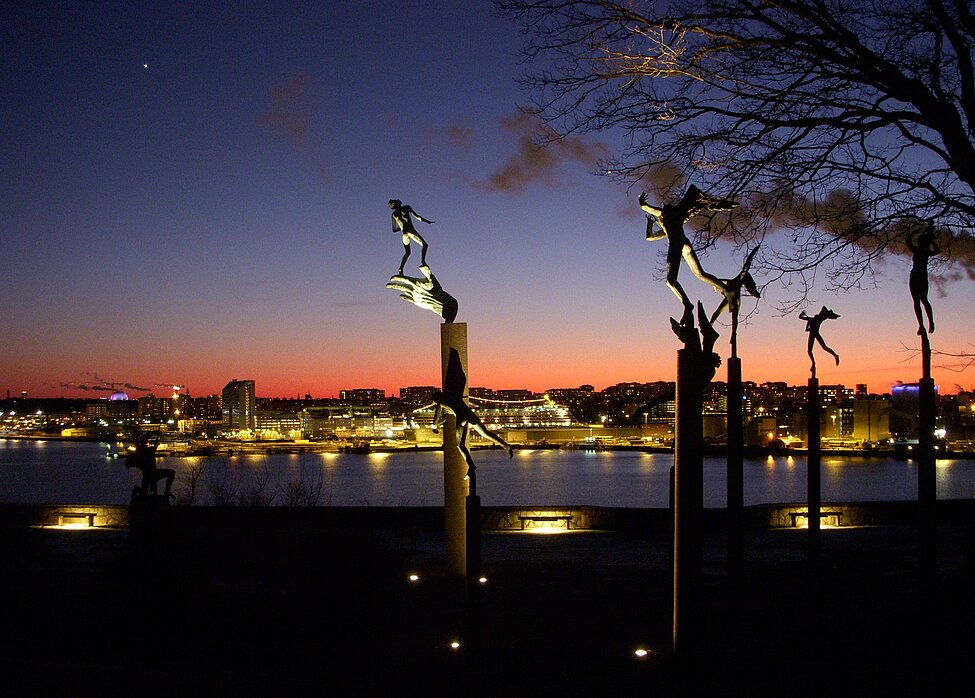
Despite the increasingly international setting of his work, Khemiri consistently returns to certain themes and motifs: the urban landscape of his hometown Stockholm, absent or ambivalent father figures, and the act of telling a story. As Massimo Ciaravolo observes, Khemiri blends Sweden’s multicultural transformation with sharp awareness and an existential focus, describing these qualities as ”intertwined and in fact impossible to seperate from one another”(Ciaravolo 2021, p.200) In doing so, Khemiri has carved out his own distinct literary space.
The organizers propose literary borderlands and border-crossings as a lens through which to read Khemiri’s work and latest literary endeavors, one that aligns with Khemiri’s own playful subversion of meaning and literary conventions. For example, in Systrarna, as many of his novels, Khemiri has included a character named Jonas. When asked by journalists about this, Khemiri responds that he has ”always been curious as to how many meanings one name can contain” (Emelino 2025). This highlights the ambiguity and fluidity inherent in his writing and what we also view as key features of Khemiri’s border-crossings and his ongoing transition to the global literary scene. Drawing on a Johan Schimanski’s framework of poetics and border(-crossing) in the context of (post-)migration, we broaden our perspective to explore questions of literary circulation, aligning with David Damrosch’s understanding of world literature as a mode of circulation and reading (Damrosch 2003, p.5). As Khemiri himself, we move from Stockholm as a situated scene to world literature.
Khemiri has become an author who transcends borders, not only in terms of language and geography but also through his approach to genre, temporality, and authorship. The organizers would like to examine this as a part of an international literary conference focused on Khemiri’s literary borderland and border-crossings. Possible dimensions of these transgressions include:
- Geographical and spatial crossing
- Temporal crossings, writing across and about generations
- Linguistic stategies, both in terms of language choice and narrative technique
- Multilingualism and translation, also in relation to the writing process
- Generic movement between literature, theater and essayistic writing
- Blurred lines between author and authorial figures
- Cosmopolitanism and the role of the city as a place and character
- Comparatistic apporaches
In addition to these literary and thematic dimension, the conference focus on how Khemiri positions himself within the Swedish literary tradition. How does he inscribe his work into the national canon – for instance, through intertextual references – and how does he strategically position himself in the literary field, for example, through a conscious internationalization of his work? Using Khemiri as a starting point, the conference also wish to contribute to a broader conversation on international literary production and the dynamics of global literary systems.
The organizers invite proposals of no more than 400 words, accompanied by a short biographical note, to be submitted by 30 June 2026 to hanna.rinderlehu-berlinde and cecilia.falkman.1hu-berlinde. Papers should be presented in English and should not exceed 20 minutes in length.
Please note that participants are expected to cover their own travel and accommodation expenses.
On 27 November, participants will also have the opportunity to attend a reading by Jonas Hassen Khemiri at the Nordic Embassies.